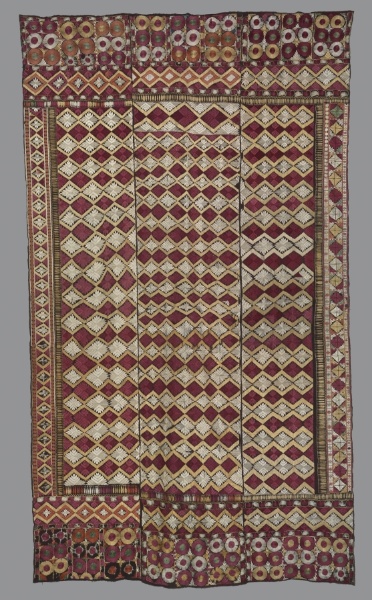
Start with the stitch
Phulkari is an embroidery tradition associated with Punjab, a region that crosses the present India–Pakistan border. The V&A describes makers working darning stitches from the reverse of a woven cotton ground, using brightly coloured floss silk. The movement of thread across the cloth produces a changing surface and sheen. Material and technique offer a firmer starting point than assigning a universal meaning to every pattern.[1]
Dense embroidered headcovers are often called bagh. The V&A distinguishes them by the extent to which stitching covers the fabric and links their making with wedding preparation. Its illustrated examples include a skirt from Bannu, dated about 1867, and a headcover from early twentieth-century Punjab. These are individual museum records, not proof that all textiles of the period followed the same design.[1]
A textile in family life
The Philadelphia Museum of Art’s 2017 catalogue introduction describes phulkaris made by women in Punjab’s towns and villages from at least the early nineteenth century into the early twentieth. For domestic use, they served as wraps at weddings and other important events. That documented period is useful; it does not settle a much earlier origin date for the craft.[2]
Global InCH describes learning and making within families, including embroidery prepared for a daughter’s trousseau. This helps explain why a textile might carry family significance as well as technical skill. The account is a broad craft description, however. It should prompt questions about a particular maker’s circumstances rather than a claim that every woman’s experience or every family custom was identical.[3]
What survives, and what remains unknown
The Philadelphia publication also notes production for commercial export, especially after Partition in 1947. A textile’s path through domestic use, sale, collection and museum display can therefore be different from that of another visually similar piece. When examining an example, record the date range, locality, materials, acquisition history and any named maker before interpreting its decorative details.[2]
An unnamed maker is a gap in the record, not an invitation to invent a life story. Nor does a geometric or floral motif establish the wearer’s religion or the object’s exact ceremonial purpose by itself. Comparing the museum’s physical description with family testimony, where permission exists, can produce better questions about labour, memory and use while preserving the distinction between evidence and interpretation.[3]
Sources & notes
Source records include access dates and, where known, limits on what was examined. Checks used AI assistance; independent human or specialist review has not been completed.
- Victoria and Albert Museum. Indian embroidery: Phulkari ↗Museum technique overview and object captions · Source date: publication date not established · Locator: “Phulkari” section; captions for museum nos. 05668(IS) and IS.24-1983. Accessed 2026-10-31.Inspected the phulkari section and the two object captions. No museum images are copied by this article.Return to At a glance: Technique ↑Return to At a glance: Materials ↑Return to At a glance: Related form ↑Return to Start with the stitch, paragraph 1 ↑Return to Start with the stitch, paragraph 2 ↑
- Philadelphia Museum of Art; edited by Darielle Mason. Phulkari: The Embroidered Textiles of Punjab from the Jill and Sheldon Bonovitz Collection ↗Museum publication record · Source date: publication date not established · Locator: 2017 catalogue record, ISBN 9780300225907; “About” paragraphs. Accessed 2026-10-31.Inspected the catalogue record and public synopsis, not the full 96-page publication. Dates, domestic use and export context are explicitly in the synopsis.Return to A textile in family life, paragraph 1 ↑Return to What survives, and what remains unknown, paragraph 1 ↑
- Global InCH, encyclopedia of intangible cultural heritage. Phulkari and Bagh Embroidery of Punjab ↗Craft reference account · Source date: publication date not established · Locator: Paragraphs on women learning from mothers and grandmothers, trousseaux and materials. Accessed 2026-10-31.Inspected the full entry; speculative ancient-origin assertions and universal claims about every girl’s dowry are not adopted.Return to A textile in family life, paragraph 2 ↑Return to What survives, and what remains unknown, paragraph 2 ↑
Record PH-CUL-0076 · English edition · human review not performed