Start with an identifiable object
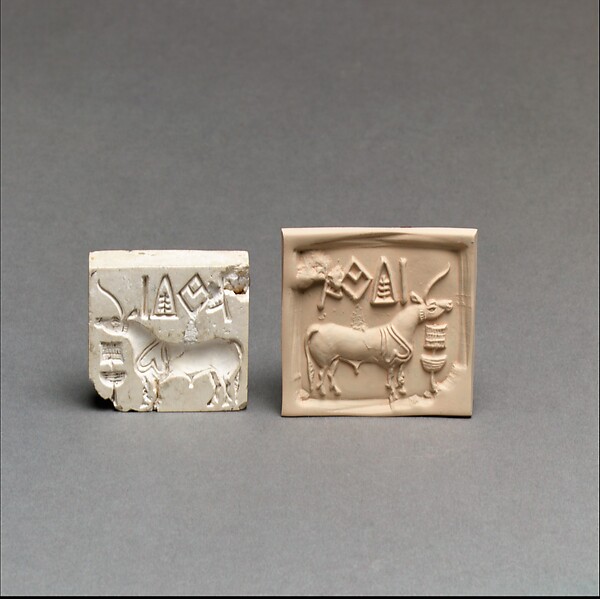
The Metropolitan Museum of Art’s seal 49.40.1 is a small square object of burnt steatite, dated in its catalogue to about 2600–1900 BCE. Its one-horned creature stands in profile before an object whose function is uncertain. Signs run above the image. The museum title includes a modern impression alongside the seal: the ancient carved surface and the newly produced imprint are related objects with different dates.[1]
The museum connects stamp seals with ownership and status, but states that the Indus script has not been fully deciphered. An animal image, a repeated sign or a plausible commercial use does not provide a verified translation of the accompanying inscription. The catalogue’s cautious identification of a possible altar or incense burner should remain cautious when a seal is used to explain Harappan religion or administration.[1]
A second seal preserves different details
Cleveland’s seal 1973.161 is catalogued as steatite, approximately 3.5 by 3.6 centimetres, and dated around 2000 BCE. Its description draws attention to the detailed markings around the creature’s neck and forequarters. The museum says that Indus seals appear to have been hung from a string through a boss on the reverse. This is a general interpretation of how seals could be carried; the description does not separately establish the construction of this particular object’s reverse.[2]
The Cleveland description offers several possible interpretations of the stand before the animal and leaves its ritual purpose unresolved. Comparing this object with the Met example therefore reveals both recurring imagery and continuing uncertainty. A shared visual pattern is worth recording, but a catalogue’s possible interpretation should not silently become a factual name for a deity, a ritual or a language.[2]
Seals were not all square animal pictures
Jonathan Mark Kenoyer’s illustrated record of seals and a terracotta sealing includes a long rectangular example from Mohenjo-daro, recorded as DK 5567 and National Museum, Karachi, NMP 50.315. It describes seven signs, a convex back and a perforation through the side. This supplies a useful counterexample to the assumption that every Indus seal had a square face bearing one large animal.[3]
That record also suggests a possible architectural interpretation for a central sign. The qualifying language is essential: identifying a repeated shape is different from proving what it meant or how it was pronounced. A careful object note records the museum or excavation identifier, material, form and observed signs first, then attributes any proposed reading. It leaves the inscription undeciphered when no established translation is available.[3]
Sources & notes
Source records include access dates and, where known, limits on what was examined. Checks used AI assistance; independent human or specialist review has not been completed.
- The Metropolitan Museum of Art. Stamp seal and modern impression: unicorn and incense burner (?) ↗museum object record · Source date: publication date not established · Locator: Object 49.40.1; opening description and Artwork Details. Accessed 2026-10-31.Inspected the public record; ownership/status is the museum’s interpretation. No decipherment is asserted and the modern impression is distinguished from the ancient seal.Return to Start with an identifiable object, paragraph 1 ↑Return to Start with an identifiable object, paragraph 2 ↑
- Cleveland Museum of Art. Seal with Unicorn and Inscription ↗museum object record · Source date: publication date not established · Locator: Object 1973.161; Details and Description. Accessed 2026-10-31.Inspected material, dimensions, date and description. The museum discusses suspension through reverse bosses generally; this article does not assert that it verified the reverse of this particular object. No findspot beyond the catalogue geography is asserted.Return to A second seal preserves different details, paragraph 1 ↑Return to A second seal preserves different details, paragraph 2 ↑
- Jonathan Mark Kenoyer / Harappa.com. Seals and sealing, Around the Indus in 90 Slides, slide 31 ↗archaeologist’s object caption · Source date: publication date not established · Locator: Caption: DK 5567; NMP 50.315; Shah and Parpola M-1271. Accessed 2026-10-31.Inspected the caption and object identifiers. Possible house/temple interpretation remains a proposal. No image or inscription has been copied into this article.Return to Seals were not all square animal pictures, paragraph 1 ↑Return to Seals were not all square animal pictures, paragraph 2 ↑
Record PH-HIS-0008 · English edition · human review not performed