Identify which text and which manuscript
The Baburnama reaches readers through different languages, manuscripts and editions. The British Library’s Or 3714 is a Persian version of memoirs originally written in Chaghatai Turkish. Its catalogue records a translation made in 1589 at Akbar’s request by Abd al-Rahim Khan. The imperial illustrated copy is dated approximately 1590–1593. The date of this manuscript is therefore different from the dates of the events narrated by Babur.[1]
The record describes 528 folios in four volumes, with four separate chronological sections. The last covers 1525–1526 to 1529–1530, at folios 348v–528v. Those folio references offer a precise starting point for an enquiry into the later campaigns. When checked on 5 November 2026, the catalogue said its digital images were unavailable. It establishes the copy’s contents and arrangement; it does not mean that the manuscript pages were available to inspect for this guide.[1]
Another illustrated copy has its own identity
The National Museum in New Delhi records manuscript 50.336 as a Persian Baburnama dated 1598. Its description lists 378 folios and 144 illustrations, with Nastaliq as the script. These details distinguish it from Or 3714. A research note should retain the accession number alongside the title, since the same title can lead to a different physical copy, a different sequence of illustrations or a modern printed edition.[2]
The museum describes subjects including battles, hunting, architecture, music and the natural world. This range makes an illustrated manuscript relevant to enquiries beyond military narrative. It also requires two separate questions: what the memoir says, and what a later artist depicts. The catalogue is a guide to locating that evidence. It cannot substitute for reading a particular page or examining a particular miniature when making a detailed historical claim.[2]
A Lahore connection, with its uncertainty preserved
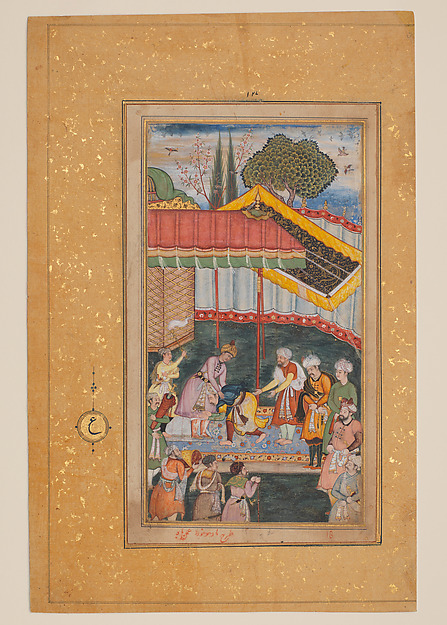
The Met’s folio 67.266.4 depicts Babur receiving a visitor beneath a tent. The museum dates it to around 1590 and locates its manufacture in present-day Pakistan, probably Lahore. That qualified attribution is a concrete Punjab connection. It concerns where this illustrated page was probably made; it does not prove that the encounter pictured took place in Lahore or that the artist witnessed it.[3]
The record identifies ink, opaque watercolour and gold on paper, and describes courtly details including clothing, a carpet and a fly whisk. Such a page can be studied as an object of Mughal book production as well as an illustration of a narrative. In a citation, give the accession number, museum date and qualified place attribution. The public-domain image shown here retains the whole folio rather than presenting a cropped scene as independent documentary evidence.[3]
Keep the English translation in the citation
The Smithsonian’s garden-research exhibition distinguishes two English versions used in its presentation. Elizabeth Moynihan worked with Annette Susannah Beveridge’s two-volume 1922 translation, while most exhibition excerpts use Wheeler Thackston’s annotated 1996 translation. A page reference from one version should not be transferred to the other without checking it. Translator, publication year, volume and page belong in a reusable quotation or research note.[4]
The exhibition also connects reading the memoir with Moynihan’s sketches, photographs, maps and garden investigations. It is a useful example of combining a narrative source with later field documentation. Follow the trail in that order: identify the wording and edition, locate the place being proposed, and compare independent material evidence. An attractive illustration or familiar modern place name alone is not enough to complete the identification.[4]
Sources & notes
Source records include access dates and, where known, limits on what was examined. Checks used AI assistance; independent human or specialist review has not been completed.
- British Library Archives and Manuscripts Catalogue. Or 3714: Vaqiat-i Baburi ↗manuscript catalogue record · Source date: publication date not established · Locator: Scope & Content; four chronological sections; Extent; Digitised Content status. Accessed 2026-11-05.Inspected the interim catalogue, not manuscript images. On 5 November 2026 the catalogue stated that digital images were unavailable. The 1589 translation and c.1590–93 copy dates are kept separate.Return to Identify which text and which manuscript, paragraph 1 ↑Return to Identify which text and which manuscript, paragraph 2 ↑
- National Museum, New Delhi / National Portal and Digital Repository for Museums of India. Babur Nama, accession 50.336 ↗museum manuscript catalogue · Source date: publication date not established · Locator: Accession, date, language, script, folio and illustration fields; Brief Description. Accessed 2026-10-31.Inspected the public catalogue. No individual miniature or Persian passage from this manuscript is represented as read.Return to Another illustrated copy has its own identity, paragraph 1 ↑Return to Another illustrated copy has its own identity, paragraph 2 ↑
- The Metropolitan Museum of Art. Emperor Babur Receiving a Visitor, folio from a Baburnama ↗museum object record · Source date: publication date not established · Locator: Object 67.266.4; description and Artwork Details; public-domain indicator. Accessed 2026-10-31.Inspected the catalogue and museum image. Probably Lahore remains a qualified attribution. The image is a later illustrated witness, not an eyewitness depiction of Babur’s reign.Return to A Lahore connection, with its uncertainty preserved, paragraph 1 ↑Return to A Lahore connection, with its uncertainty preserved, paragraph 2 ↑
- Smithsonian National Museum of Asian Art. Discovering Babur’s Gardens: Enter the Gardens ↗museum research exhibition · Source date: publication date not established · Locator: Exhibition introduction; About the Translations of the Baburnama. Accessed 2026-10-31.Inspected the exhibition text and its named translation distinction. Neither complete English edition was read for this guide, and no quotation from either is supplied.Return to Keep the English translation in the citation, paragraph 1 ↑Return to Keep the English translation in the citation, paragraph 2 ↑
Record PH-COL-0015 · English edition · human review not performed