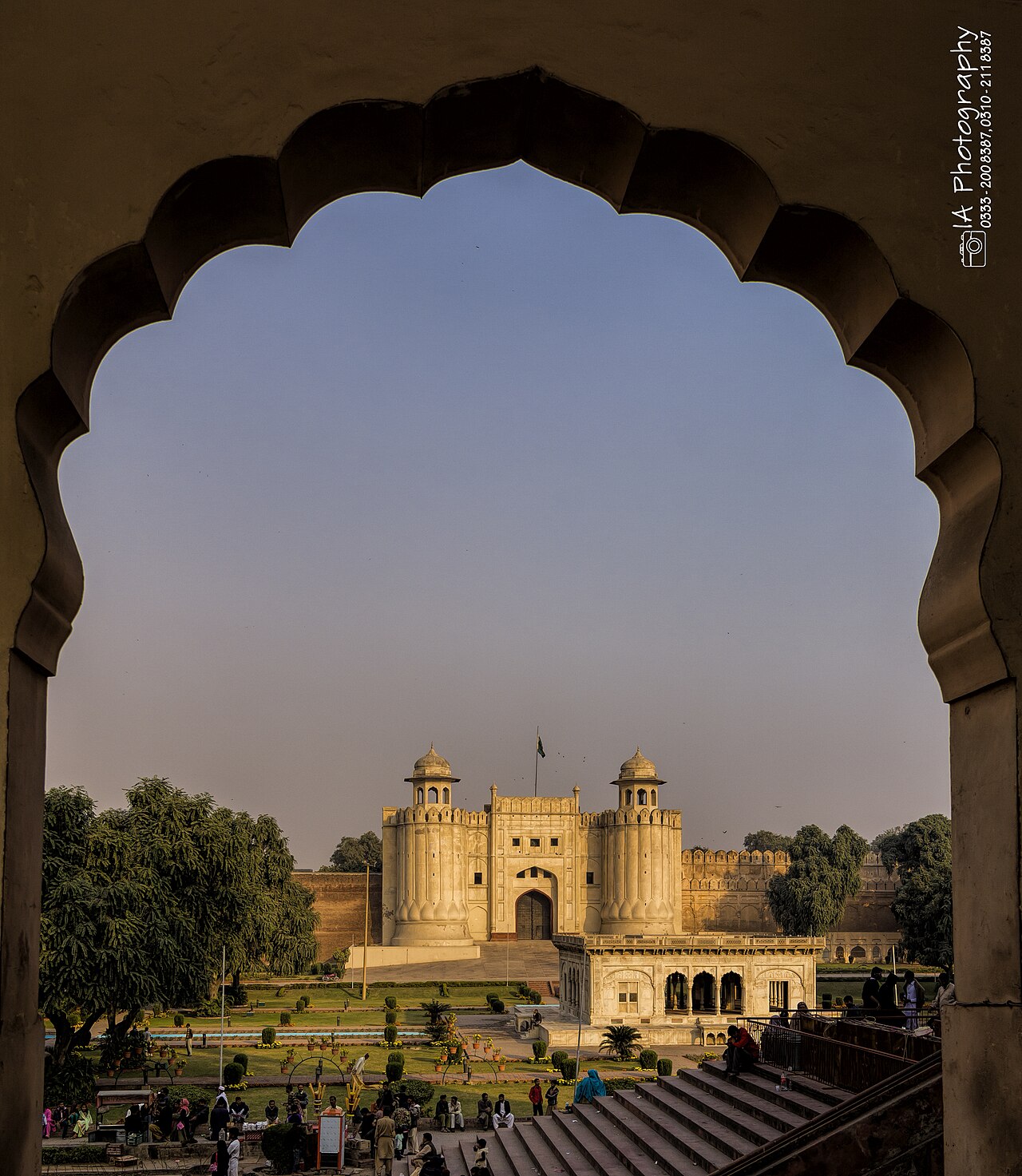
A city and its historic core
Lahore is the capital of Punjab province in Pakistan. Its Walled City preserves a dense historic urban form within a much larger modern city. The Aga Khan Trust for Culture’s conservation account treats this quarter as an inhabited urban district: its houses, small businesses and utilities belong to the story alongside its celebrated monuments. The distinction matters when a source says Lahore; it may describe a province’s capital, a municipality or this particular old-city neighbourhood.[1]
Read the layers, not a single age
The heritage authority’s city history identifies Mughal mosques, Sikh-period havelis and later alterations to the city’s gates and enclosing walls. These surviving structures offer different starting points for research. A gate’s present appearance is not by itself proof that every part belongs to the same ruler or century. The authority also repeats a legendary origin story; this guide does not treat that tradition as an established founding date.[2]
The street is part of the archive
Gali Surjan Singh provides a useful counterpoint to the royal monuments. AKTC describes a residential conservation project begun in 2010 that combined repairs to historic houses and storefronts with improvements to water, drainage and electricity infrastructure. This work shows why urban conservation concerns living conditions as well as attractive facades. The documented intervention allows a reader to ask which surfaces are old, which were repaired and how services were incorporated.[1]
The authority’s inventory of gates and havelis also makes it possible to follow smaller-scale buildings through the city. Its account links Haveli Nau Nihal Singh and other residences with the Sikh period. Such a building can be read as evidence of patronage and domestic architecture without assuming that the whole neighbourhood had one community identity. A named monument is one documented connection, not a census of everyone who lived nearby.[2]
A history still being conserved
Conservation has its own chronology. In May 2026, UNESCO reported that restoration of the northern section of Lahore Fort’s Picture Wall had been completed the previous month. The report describes documentation, materials analysis and training before physical intervention. Read such dated reports beside historical descriptions: they explain why a visitor’s photograph, an older survey and the surviving fabric may differ. They also record the contemporary labour through which historic places remain legible.[3]
Sources & notes
Source records include access dates and, where known, limits on what was examined. Checks used AI assistance; independent human or specialist review has not been completed.
- Aga Khan Development Network. Pakistan — Walled City of Lahore Conservation ↗institutional history · Source date: publication date not established · Locator: Opening overview; Shahi Guzargah pilot project; Gali Surjan Singh Conservation Project. Accessed 2026-10-31.Inspected the urban-conservation overview and named residential project; supports modern provincial setting, living urban fabric and 2010 intervention.Return to At a glance: Scope ↑Return to At a glance: Modern setting ↑Return to A city and its historic core, paragraph 1 ↑Return to The street is part of the archive, paragraph 1 ↑
- Punjab Walled Cities & Heritage Areas Authority. History of Lahore’s Walled City ↗institutional history · Source date: publication date not established · Locator: A little from History, paragraphs on Mughal monuments, Sikh havelis, and British changes. Accessed 2026-10-31.Inspected the substantive history paragraphs. Mythical origins and unrelated template timeline content are excluded; used narrowly for named built heritage.Return to Read the layers, not a single age, paragraph 1 ↑Return to The street is part of the archive, paragraph 2 ↑
- UNESCO Pakistan. Completion of the Picture Wall Restoration at the World Heritage property of the Lahore Fort ↗conservation report · Source date: publication date not established · Locator: 11 May 2026 article, opening report and Science at the Heart of Conservation. Accessed 2026-10-31.Inspected dated UNESCO report; northern section completed April 2026. This is not a claim that all Fort conservation is finished.Return to A history still being conserved, paragraph 1 ↑
- Muhammad Yaqoob Asi; Urdu Mehfil forum. Punjabi orthography discussion: a contributor’s place names ↗Punjabi-language discussion post, written form · Source date: 2010-09-07 · Locator: Post 26: Punjabi-script discussion and place-name list. Accessed 2026-11-04.The contributor’s Punjabi text was inspected for this particular spelling. It illustrates recorded usage, not a universal spelling or a verified map of dialect boundaries; the post’s classification opinions are not adopted here. On 5 November 2026 the indexed extract contained this spelling; direct retrieval timed out in the checking environment. Access may vary.Return to Script form 1 ↑
- GeoNames. Lahore, Pakistan ↗geographical names database · Source date: publication date not established · Locator: Coordinates and feature code P.PPLA, GeoNames ID 1172451. Accessed 2026-11-04.Inspected the Lahore populated-place record and its coordinates. The point is a modern geographic reference, not a surveyed historical boundary or a marker for the Walled City.
Record PH-PLA-0001 · English edition · human review not performed