Punjab in an unsettled political world
Akbar’s connection with Punjab began before his long imperial reign. Fritz Lehmann identifies him as governor of Punjab at Humayun’s death and places his proclamation as emperor in 1556 within continuing struggles with Sur claimants. The later consolidation of the empire joined Punjab’s agricultural resources with commercial regions including Gujarat. This political sequence helps explain Punjab as part of a wider imperial network. It does not imply that authority was secure everywhere at the moment a ruler took a title.[1]
The court’s Lahore workshop
The Metropolitan Museum of Art’s historical essay identifies 1585 as the year when Akbar adopted Lahore as his principal residence. A royal workshop that had operated at Fatehpur Sikri continued at Lahore, producing illustrated manuscripts for the emperor. The museum emphasises collaboration among Persian artists and Indian Muslim and Hindu painters, with European visual elements also entering the work. Lahore’s importance thus includes skilled production, the movement of artists and the making of books. This was a courtly artistic setting; it cannot stand for all artistic practice or every resident’s access to the court.[2]
One surviving folio and a qualified attribution
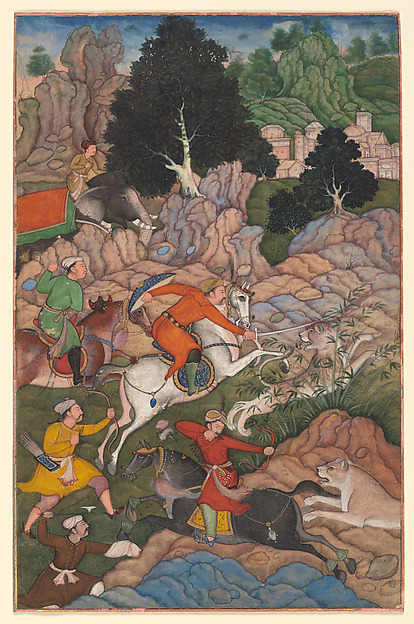
A surviving Akbarnama folio in the Met, object 11.39.2, depicts Akbar hunting. Its catalogue dates the page to the late sixteenth century and attributes its production to present-day Pakistan, probably Lahore. That qualification matters. The image presents imperial courage through a dramatic hunt, while its materials include opaque watercolour, ink and gold on paper. It is evidence of how royal action was represented in a dispersed illustrated chronicle, rather than an independently verified photograph-like record of a particular encounter. In the museum’s description, the emperor strikes a lioness from his saddle while another rider shoots backwards towards a second lion. The scene’s composition makes physical danger and courtly prowess central to its royal portrait.[3]
Sources & notes
Source records include access dates and, where known, limits on what was examined. Checks used AI assistance; independent human or specialist review has not been completed.
- Fritz Lehmann; Encyclopaedia Iranica. Akbar I ↗Inspected scholarly research or institutional evidence · Source date: 1984-12-15; updated 2018-06-14 · Locator: Vol. I/7 pp.707–711; early Punjab government, political career and revenue-administration paragraphs. Accessed 2026-11-01.Actual authored entry read, including source bibliography. Specific political and administrative claims are used; rankings of rulers, sweeping communal judgments, numerical tax prescriptions and claims to universal implementation are excluded.Return to Punjab in an unsettled political world, paragraph 1 ↑
- Department of Islamic Art; The Metropolitan Museum of Art. The Art of the Mughals before 1600 ↗Inspected scholarly research or institutional evidence · Source date: 2002-10 · Locator: Concluding paragraphs on Lahore residence in 1585, the royal atelier and collaborative manuscript painting. Accessed 2026-11-01.Actual complete museum essay read. Its geographical and artistic sequence is used, without reproducing rankings or generalised religious-character judgments. Older TOAH and translated URL versions remain the same work.Return to The court’s Lahore workshop, paragraph 1 ↑
- The Metropolitan Museum of Art. Akbar Hunting, Folio from an Akbarnama, object 11.39.2 ↗Inspected scholarly research or institutional evidence · Source date: Not established for current catalogue text · Locator: Object overview, late-sixteenth-century date, probable Lahore geography, medium and object number. Accessed 2026-11-01.Actual museum record and curatorial description inspected. The attribution says probably Lahore and remains qualified. The page is not a dated eyewitness record of the depicted hunt. The image’s separate credit records this CC0 reproduction.Return to One surviving folio and a qualified attribution, paragraph 1 ↑
Record PH-HIS-0051 · English edition · human review not performed