A region crossing today’s categories
Gandhara was a northwestern region associated with settlements on both sides of the Indus. Willem Vogelsang’s reference account identifies Taxila and Pushkalavati, near modern Charsadda, as important centres. Taxila supplies a direct connection with present-day Pakistani Punjab; the wider region also extended beyond that province. A modern administrative map is therefore useful for locating sites, but cannot substitute for the geographical meaning of an ancient regional name. The scale must be stated each time the name is used.[1]
Gandhari is a language, not a map outline
Richard Salomon describes Gandhari as a Middle Indo-Aryan language, documented in inscriptions, manuscripts, coin legends and administrative records. Its literary and practical use extended beyond the region’s core, especially under the Kushans. He distinguishes the language from Kharoshthi, the script in which it was written. A manuscript’s language can consequently connect several places without placing them inside one political boundary. Nor does the survival of a literary language tell us that everyone in the area spoke in precisely the same way.[2]
A specific act of patronage
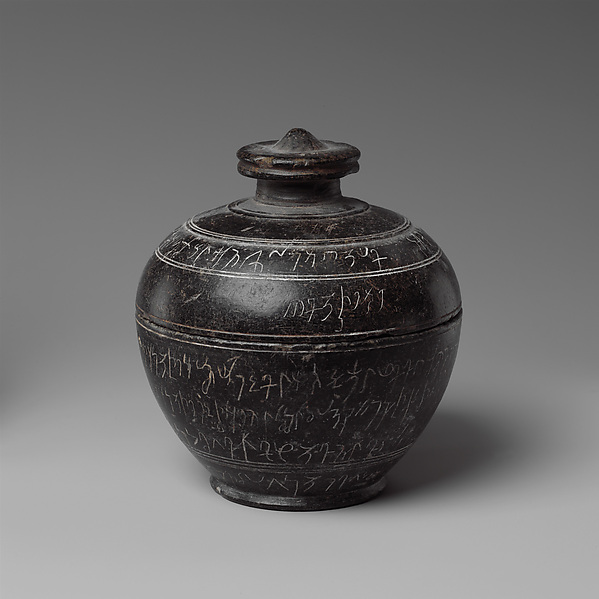
A schist reliquary at the Metropolitan Museum, object 1987.142.70a, b, makes the regional story more concrete. Its inscription records Prince Indravarman establishing relics of Shakyamuni and associating the act with merit for family members. The catalogue locates the object in the Bajaur area of ancient Gandhara and dates it to 15–16 CE. A named dedication tells us something different from a general description of artistic style: it connects a donor, an object and a religious purpose.[3]
The reliquary is a specific record from the wider Gandharan world, rather than an object excavated at Taxila. Keeping that distinction visible lets the evidence illuminate regional connections without moving its find or origin to a better-known city. Its museum date should be cited as the catalogue’s dating of the object, with its accession number retained for comparison and future correction.[3]
Sources & notes
Source records include access dates and, where known, limits on what was examined. Checks used AI assistance; independent human or specialist review has not been completed.
- Willem J. Vogelsang / Encyclopaedia Iranica. Gandhara ↗scholarly reference · Source date: 2000; updated 2016 · Locator: Opening geographical description; X/3, pp. 269–270. Accessed 2026-11-01.Read the full entry. Used the geographical description, without adopting its inferred ancient ethnic classifications as modern identities.Return to A region crossing today’s categories, paragraph 1 ↑
- Richard Salomon / Encyclopaedia Iranica. Gandhari Language ↗scholarly linguistic reference · Source date: 2008; updated 2013 · Locator: General; Attestation; opening language and script discussion. Accessed 2026-11-01.Read the identified passages; no human specialist review is claimed.Return to Gandhari is a language, not a map outline, paragraph 1 ↑
- The Metropolitan Museum of Art. Inscribed Reliquary, Donated by King Indravarman ↗museum object record · Source date: publication date not established · Locator: Object 1987.142.70a, b; translated inscription and Artwork Details. Accessed 2026-11-01.Read the object record. Its 15–16 CE date differs from the 5–6 CE date in the older 2012 Gandhara essay; this article follows the specific object catalogue and does not silently reconcile them.Return to A specific act of patronage, paragraph 1 ↑Return to A specific act of patronage, paragraph 2 ↑
Record PH-HIS-0016 · English edition · human review not performed