Punjab within a wider network
Kushan power connected Bactria with Gandhara and Taxila during the early centuries CE. Jason Neelis’s University of Washington essay brings together archaeology, inscriptions and coins to investigate those links. It reports a large concentration of Kujula Kadphises coins in the latest occupation at Sirkap, before the principal settlement moved to Sirsukh under his successors. A coin assemblage within a settlement sequence offers more specific evidence than a broad imperial colour on a map.[1]
Neelis also distinguishes political control from wider commercial and religious contact. Connections across mountain routes need not imply that every distant place was governed directly by the Kushans. His discussion makes the region’s importance visible while retaining questions about chronology and the interpretation of individual inscriptions.[1]
A dated object, with a cautious label
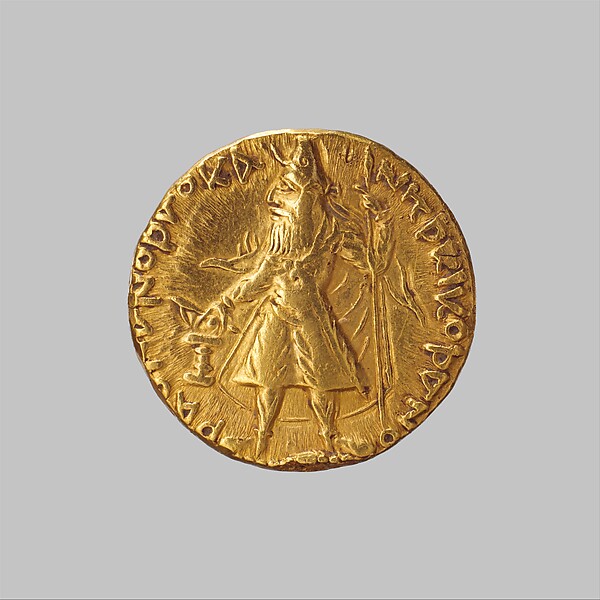
The Metropolitan Museum catalogues a gold coin of Kanishka, object 99.35.3024, at about 130 CE and attributes it to ancient Gandhara. Its accompanying text discusses a currency displaying rulers in relation to several Near Eastern and South Asian deities. The catalogue’s approximate object date is useful evidence for this particular record. It is not, by itself, an exact accession date for the king or a complete map of the empire’s religious practices.[2]
Greek letters do not always mean Greek language
Nicholas Sims-Williams’s account of Bactrian explains an important change in Kushan written culture. Bactrian is an Iranian language written with an adapted Greek alphabet. Early Kanishka issues used Greek legends, while later ones used Bactrian. Recognising the shape of a Greek letter therefore does not settle the language of a coin. This distinction helps readers understand the northwest’s connected written traditions without treating language, script, dynasty and religious identity as interchangeable. The inscriptions and coins need to be identified individually before broader conclusions are drawn. Letter shapes must therefore be read alongside vocabulary and the identity of the specific issue.[3]
Sources & notes
Source records include access dates and, where known, limits on what was examined. Checks used AI assistance; independent human or specialist review has not been completed.
- Jason Neelis / University of Washington, Silk Road Seattle. The Kushan Empire ↗scholarly exhibition essay · Source date: publication date not established · Locator: Paragraphs on Taxila/Sirkap, Kujula Kadphises, connections and control. Accessed 2026-11-01.Read the full essay. Its tentative older absolute chronology is not adopted; the article uses broad centuries and separately dated object metadata.Return to Punjab within a wider network, paragraph 1 ↑Return to Punjab within a wider network, paragraph 2 ↑
- The Metropolitan Museum of Art. Coin of Kanishka ↗museum object record · Source date: publication date not established · Locator: Object 99.35.3024; description and Artwork Details. Accessed 2026-11-01.Read the record. The comparative description refers to several Kushan coins; its mention of Shiva on Vasudeva’s coin is not misassigned to this Kanishka object.Return to A dated object, with a cautious label, paragraph 1 ↑
- Nicholas Sims-Williams / Encyclopaedia Iranica. Bactrian Language ↗scholarly linguistic reference · Source date: 1988; updated 2016 · Locator: Opening definition; Historical background; Sources, section 1 Coins. Accessed 2026-11-01.Read the identified passages; no human specialist review is claimed.Return to Greek letters do not always mean Greek language, paragraph 1 ↑
Record PH-HIS-0026 · English edition · human review not performed