Teaching connections between Sindh and Lahore
Mian Mir was a Qadiri Sufi teacher whose life connected Sindh with Lahore. Nisar Ahmad Faruqi’s reference account places his early formation around Sivistan, or Sehwan, and describes further religious study in Lahore. It records his association with the Qadiri teacher Khizr Sivistani and later disciples including Mulla Shah. This geographical and teaching context is more specific than treating him simply as a symbol of an undated religious harmony. The account also identifies his sister Bibi Jamal as an important Qadiri woman in Punjab.[1]
Faruqi names Dara Shikoh’s Safinat al-Awliya and Sakinat al-Awliya, together with Jahangir’s memoir, among early sources for the life. These are identified research routes, rather than works claimed as completely read here. Courtly and devotional accounts require their own context when used for particular encounters or teachings.[1]
Retain disagreement in the life dates
The TDV entry gives 1550 as his birth year, while the Ashmolean’s subject record gives 1531. Both place his death in 1635. The discrepancy remains visible; the paintings’ production dates should not be substituted for either date in the subject’s life.[1][3]
Later portraits preserve a teaching relationship
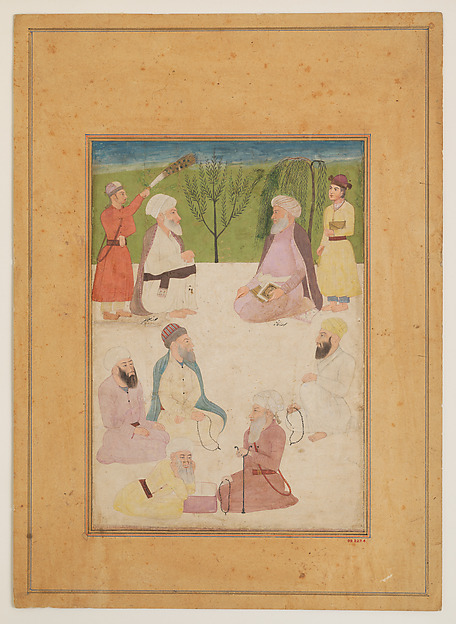
The Met’s watercolor, accession 09.227.4, is attributed to Muhammad Musa and to Kashmir around 1695–1705. Its description connects Mulla Shah with the initiation of Dara Shikoh and Jahanara Begum in 1640. Those are Mulla Shah’s relationships and activities, rather than events reassigned to Mian Mir. The object’s date also places its making after Mian Mir’s death. It preserves a later pictorial tradition, not proof that the figures sat together for this particular artist.[2]
The Ashmolean holds a separate late-seventeenth-century gouache, EA1990.1287, showing Mian Mir with Mulla Shah. Its description identifies the Lahore shaikh conversing with his disciple and notes that the pair were often depicted together. The two museum records consequently make a remembered teaching connection visible through different surviving objects. Keeping each accession, attribution and approximate date allows comparison without collapsing them into one original portrait or claiming that their imagery documents an eyewitness meeting.[3]
Sources & notes
Source records include access dates and, where known, limits on what was examined. Checks used AI assistance; independent human or specialist review has not been completed.
- Nisar Ahmad Faruqi / TDV İslâm Ansiklopedisi. Miyân Mîr ↗authored scholarly reference · Source date: 2020 · Locator: Opening life account; education and Lahore; disciples and early-source paragraph; printed volume30, pp.200–201. Accessed 2026-11-01.Read the complete Turkish entry and its bibliography. English paraphrase, no translated quotation. Exact death-day variants, genealogical descent, miracles and the Harmandir foundation story are not adopted. Named early works are identified through this reference, not falsely claimed read in full.Return to Teaching connections between Sindh and Lahore, paragraph 1 ↑Return to Teaching connections between Sindh and Lahore, paragraph 2 ↑Return to Retain disagreement in the life dates, paragraph 1 ↑
- The Metropolitan Museum of Art. Portrait of Mian Mir and Mulla Shah ↗museum object record · Source date: publication date not established · Locator: Object09.227.4; attributed artist/place, approximate1695–1705 date and Mulla Shah/Dara/Jahanara description. Accessed 2026-11-01.Read the full description and artwork details. Attributed and approximate qualifications retained. The1640 initiations concern Mulla Shah, not Mian Mir. Actual API confirms public-domain status; unchanged museum image visually inspected. No unseen Lahore album or V&A object is claimed read.Return to Later portraits preserve a teaching relationship, paragraph 1 ↑
- Ashmolean Museum, University of Oxford. The Sufi saints Mian Mir and Mulla Shah ↗museum object record · Source date: publication date not established · Locator: EA1990.1287; Description and Details: late17th-century gouache, north India, subjects and accession. Accessed 2026-11-01.Read actual description and details. Uses its qualified object date and teacher/disciple description. The subject’s 1531 label differs from TDV 1550; exact day is omitted. Current display location is not promised, and no Ashmolean image is reproduced.Return to Retain disagreement in the life dates, paragraph 1 ↑Return to Later portraits preserve a teaching relationship, paragraph 2 ↑
Record PH-PEO-0042 · English edition · human review not performed