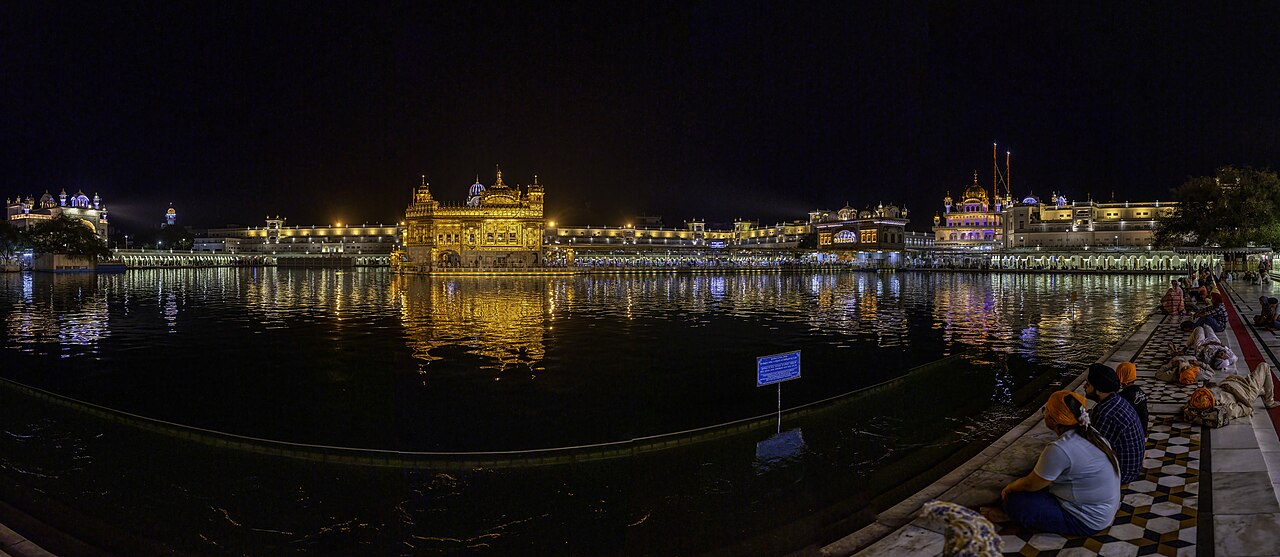
A sacred centre with several historical layers
The SGPC’s history connects the sarovar, or sacred tank, with Guru Ram Das and the development of the central place of worship with Guru Arjan. It records the installation of the newly compiled scripture at Harmandir Sahib in 1604 and the appointment of Baba Buddha as the first granthi. This identifies a specific institutional and devotional milestone, rather than merely a date for an architectural object standing apart from the Sikh community.[1]
Harvard’s Pluralism Project distinguishes Guru Arjan’s late-sixteenth- and early-seventeenth-century construction phase from the present structure completed in the early nineteenth century. It connects the familiar name Golden Temple with the gilded dome. The distinction matters: the sacred centre has continuity of significance while its fabric has a history of rebuilding. Neither the original foundation nor a later exterior alone accounts for the whole site’s history.[2]
Modern infrastructure has a history too
United Sikh Mission’s project documentation records completion of a 525-kilowatt-peak solar installation for the Harmandir Sahib complex on 23 December 2021. Its building schedule identifies accommodation blocks, offices and other facilities, including Teja Singh Samundri Hall. The documented work concerns the wider complex’s roofs; it should not be imagined as panels laid across the sanctuary’s gilded dome. The date and capacity describe a particular intervention in the infrastructure of a working site.[4]
The report also covers other gurdwaras, so its combined project total must not be assigned entirely to Harmandir Sahib. Its electricity-generation figures are estimates rather than an independently measured account of later output. Used within those limits, the document makes a practical part of contemporary care visible: maintaining buildings and services requires infrastructure beyond the shrine itself. This layer of work joins a much longer history of devotion, construction and institutional organisation.[4]
Sources & notes
Source records include access dates and, where known, limits on what was examined. Checks used AI assistance; independent human or specialist review has not been completed.
- Shiromani Gurdwara Parbandhak Committee. Sri Harmandir Sahib ↗religious institution’s historical and architectural account · Source date: publication date not established · Locator: Historical paragraphs on Guru Ram Das/Guru Arjan and 1604 installation; platform, causeway, entrances and upper structure description. Accessed 2026-10-31.Inspected article text. Attributes the institution’s interpretation of access and architecture; conflicting completion-date wording, disputed Mian Mir foundation attribution and generalisations about other religions’ buildings are excluded.Return to A sacred centre with several historical layers, paragraph 1 ↑Return to Architecture, scripture and shared service, paragraph 1 ↑
- The Pluralism Project, Harvard University. Golden Temple ↗university religious-history reference · Source date: publication date not established · Locator: Complete short historical entry. Accessed 2026-10-31.Inspected short entry distinguishing Guru Arjan’s construction phase from the early-nineteenth-century present structure and gilded-dome name. It does not substantiate precise gold weights or a full reconstruction chronology.Return to A sacred centre with several historical layers, paragraph 2 ↑
- District Administration Amritsar. Sachkhand Sri Harmandir Sahib Sri Darbar Sahib ↗official religious-place account · Source date: publication date not established · Locator: Closing historical paragraph on kirtan, Guru Granth Sahib and langar/pangat. Accessed 2026-10-31.Inspected worship and service description. Much earlier history overlaps SGPC’s narrative and is not treated as independent corroboration. Undated attendance totals and current schedules are excluded. Date metadata observed: not established; page updated 2024-01-09.Return to Architecture, scripture and shared service, paragraph 2 ↑
- United Sikh Mission; Hartek Solar project documentation. Solar Photovoltaic Power Plant: project report ↗primary project completion and technical documentation · Source date: publication date not established · Locator: Printed pp. 7, 10–11 (PDF pp. 8, 11–12): project chronology, location coordinate, Harmandir complex building schedule. Accessed 2026-10-31.Downloaded official project PDF and inspected tables. Harmandir-complex capacity is 525 kWp completed 2021-12-23; the wider four-site total is not attributed to this complex. Estimated generation is not claimed as measured performance. Coordinate 31.62N,74.88E is a broad complex reference. Date metadata observed: not established; completed phases 2021–2023; hosted 2023-07.Return to Modern infrastructure has a history too, paragraph 1 ↑Return to Modern infrastructure has a history too, paragraph 2 ↑
Record PH-PLA-0229 · English edition · human review not performed