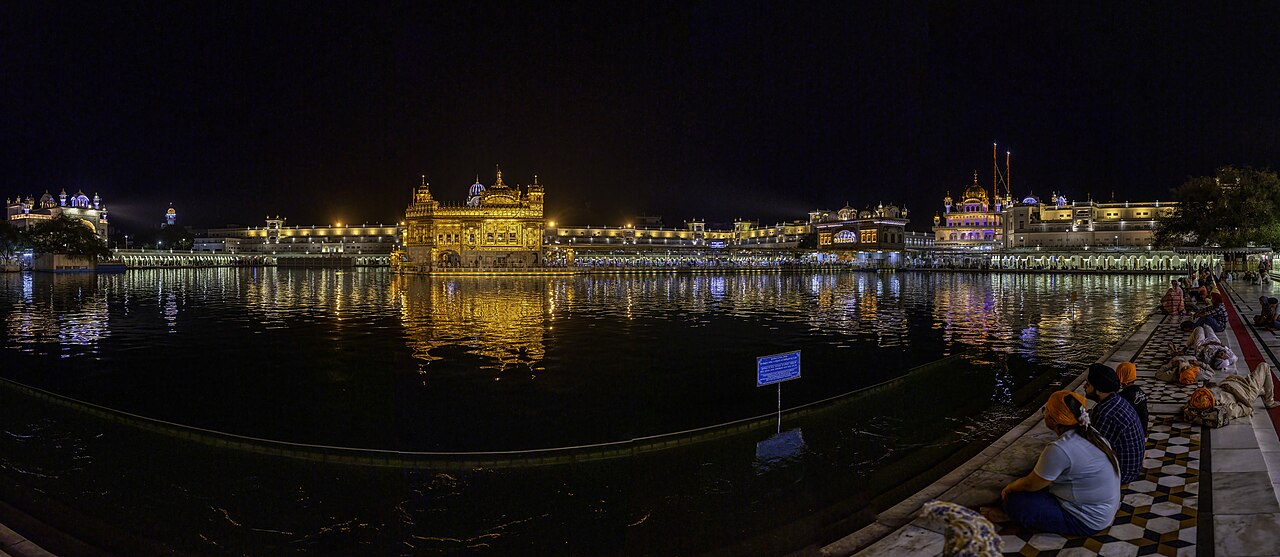
A settlement takes shape
The district administration’s history associates Amritsar’s foundation with Guru Ram Das in about 1574. It describes an invitation to traders from places including Patti and Kasur, and the settlement’s earlier name, Ramdaspur. This account puts commerce alongside religious patronage at the beginning of the city’s story. It is more informative than treating the later metropolis as a shrine with buildings added around it, because it identifies settlement and exchange as part of the foundation narrative.[1]
Sarovar and city
The SGPC’s institutional history distinguishes Guru Ram Das’s move to the settlement in 1574 from the start of excavation of the Amritsar Sarovar in 1577. It describes further work under Guru Arjan and the installation of the first scripture volume at Darbar Sahib in 1604. These stages explain why brief descriptions can give different dates for the city’s beginnings. Establishing a residence, organising a settlement, excavating water and completing a major shrine were different developments.[2]
Place the city within its landscape
A Government of India industrial profile locates the district in the Bari Doab, the tract between the Ravi and Beas. It discusses a larger administrative area than the city itself. That distinction is essential when reading district statistics or older descriptions: a figure for cultivated land, villages or industrial units cannot automatically describe the urban centre. The historical place names Ramdaspur and Guru-ka-Chak in the same profile provide additional routes into catalogues and local histories.[3]
Look beyond the principal monument
The industrial profile also records Khalsa College’s establishment in 1892 and Guru Nanak Dev University’s in 1969. Its tables and industry sections document textile production, food processing, printing, machinery and other activities in the district. These are dated records, not current economic totals. They offer a way to broaden a research question from famous buildings to institutions, workshops, skills and the everyday work on which a city depends.[3]
For a first reading, keep three scales in view: the Harmandir Sahib complex, the settlement that grew around the sarovar, and the wider district. The district’s own foundation account moves between traders, streets and the sacred pool. Following those connections makes room for urban history as well as institutional history, while avoiding the assumption that the experience of every inhabitant can be represented by one building or one founding episode.[1][2]
Sources & notes
Source records include access dates and, where known, limits on what was examined. Checks used AI assistance; independent human or specialist review has not been completed.
- District Administration Amritsar, Government of Punjab. About District ↗institutional history · Source date: publication date not established · Locator: About District, foundation and Amrit Sarovar paragraphs. Accessed 2026-10-31.Inspected actual page text using a direct read after intermittent browser timeouts. Supports attributed foundation account, traders, Ramdaspur and Guru Arjan’s completion.Return to At a glance: Settlement associated with ↑Return to A settlement takes shape, paragraph 1 ↑Return to Look beyond the principal monument, paragraph 2 ↑
- Shiromani Gurdwara Parbandhak Committee. The City — Amritsar ↗institutional self-history · Source date: publication date not established · Locator: Opening paragraphs: 1574 settlement, 1577 sarovar excavation, Guru Arjan’s works. Accessed 2026-10-31.Institutional self-history inspected; used for its distinct settlement and excavation dates, not to settle contested details or claims about violence.Return to At a glance: Settlement associated with ↑Return to Sarovar and city, paragraph 1 ↑Return to Look beyond the principal monument, paragraph 2 ↑
- MSME Development Institute Ludhiana, Government of India. Brief Industrial Profile of Amritsar District ↗government district profile · Source date: publication date not established · Locator: Printed pp. 2–3: General Characteristics, Location & Topography; pp. 7–9: industrial sections. Accessed 2026-10-31.Inspected PDF. Historical institutional dates and district setting used; circa-2011 economic tables are not presented as current data.Return to At a glance: Earlier names ↑Return to At a glance: Geographical setting ↑Return to Place the city within its landscape, paragraph 1 ↑Return to Look beyond the principal monument, paragraph 1 ↑
- District Administration Amritsar, Government of Punjab. Amritsar district portal, Punjabi version ↗Government website, script form · Source date: publication date not established · Locator: Punjabi-language district homepage and place name. Accessed 2026-11-04.The district portal’s Punjabi-language page was checked for this written place name. The name is supplied as a searchable form, not as evidence for a historical boundary or etymology.Return to Script form 1 ↑
Record PH-PLA-0091 · English edition · human review not performed