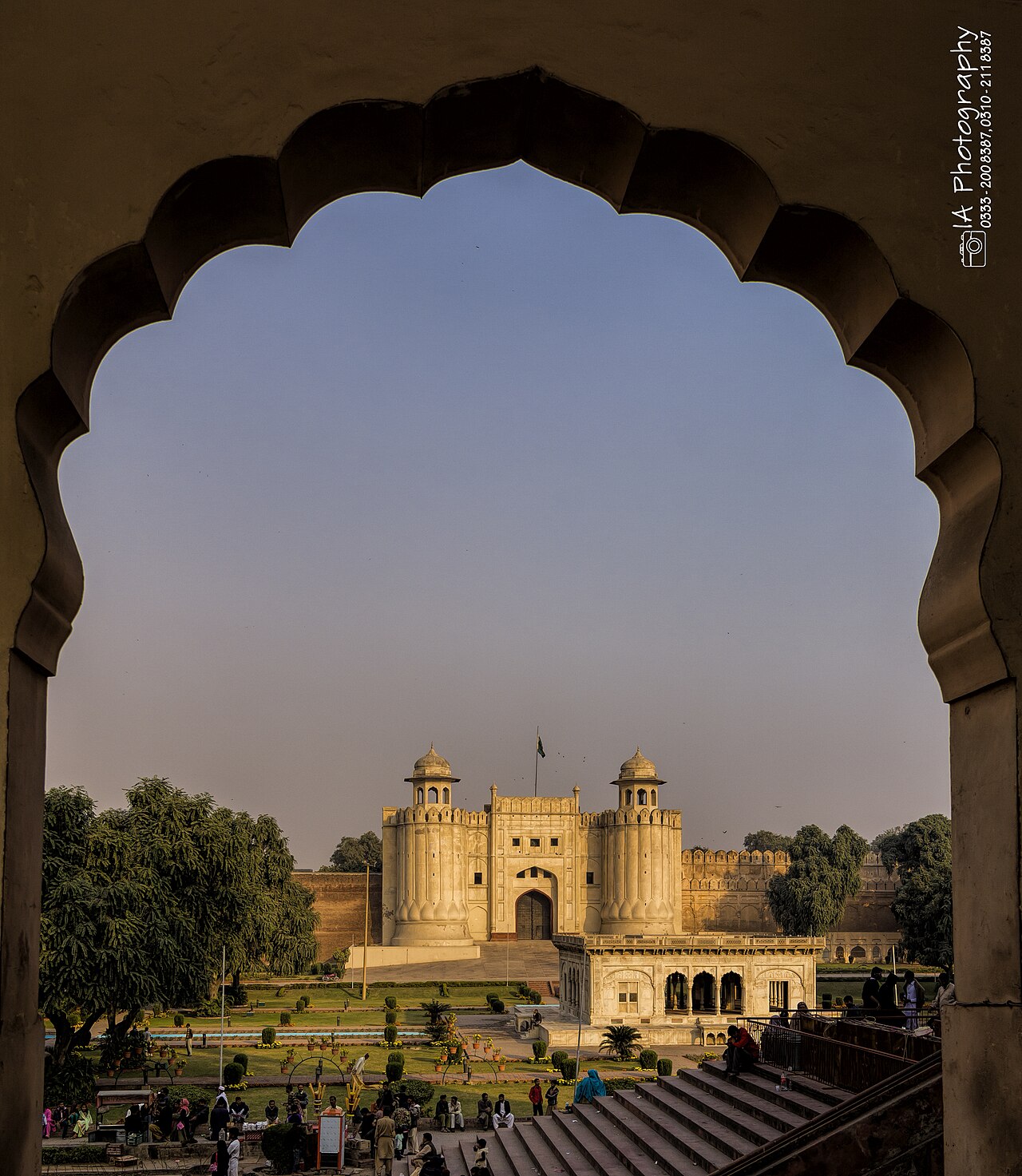
A complex, not a single building
The federal archaeology inventory places Lahore Fort at the northern end of the Walled City. Its description identifies a complex containing 21 notable monuments, including buildings associated with Akbar and Shah Jahan. The broad label fort can hide that variety. Audience spaces, residential chambers, gates and decorative structures served different purposes. They should be read through their individual dates and relationships rather than treated as one structure completed at a single moment.[1]
Trace successive building campaigns
The local heritage authority dates Akbar’s rebuilding in burnt brick to about 1566 and describes later additions under Jahangir, Shah Jahan and Aurangzeb. It also identifies Sikh-period additions and the subsequent British occupation. The sequence is the key to understanding the site. A building’s current location inside a Mughal-period enclosure does not establish that every floor, roof or adjacent pavilion belongs to its earliest construction. Surviving fabric and later alterations need separate attention.[2]
Look closely at materials
The archaeology inventory describes the Naulakha Pavilion’s white marble and curved roof, and the Sheesh Mahal’s mirrorwork and inlaid surfaces. It dates the latter to 1631–32 under Shah Jahan. These are specific architectural observations, not simply evidence of wealth in the abstract. Materials, finish and the arrangement of private spaces can help a reader ask how patronage was expressed and how particular parts of the complex differed in access and function.[1]
Conservation adds another chronology
The Picture Wall provides a second way into the fort’s history. UNESCO’s May 2026 report describes seventeenth-century glazed tile, fresco, stone and terracotta decoration with courtly, animal, floral and geometric subjects. It records completion of restoration of the northern section in April 2026, following years of documentation and scientific investigation. The date concerns that conservation campaign; it does not mean that every part of the fort has been restored or that its appearance is unchanged.[3]
The authority’s historical account also describes changes made during the fort’s military use, including alteration of an enclosing wall before its transfer to the Archaeological Survey of India in 1927. Read that institutional history alongside the recent conservation record. Together they distinguish creation, adaptation and preservation. For map use, UNESCO’s component coordinate identifies a representative location for the complex; it cannot establish the position of an undocumented event or the perimeter of an earlier fort.[2][4]
Sources & notes
Source records include access dates and, where known, limits on what was examined. Checks used AI assistance; independent human or specialist review has not been completed.
- Federal Department of Archaeology and Museums, Pakistan. Lahore Fort — site record 6502 ↗heritage inventory · Source date: publication date not established · Locator: Description; Shah Burj Quadrangle, Naulakha Pavilion and Sheesh Mahal paragraphs. Accessed 2026-10-31.Inspected detailed inventory; supports monuments, materials and stated Shah Jahan-period dates.Return to At a glance: Present-day setting ↑Return to At a glance: Building sequence ↑Return to A complex, not a single building, paragraph 1 ↑Return to Look closely at materials, paragraph 1 ↑
- Punjab Walled Cities & Heritage Areas Authority. Lahore Fort: History, Architecture & World Heritage Site ↗institutional history · Source date: publication date not established · Locator: Lahore Fort history paragraphs on Akbar, later Mughal additions, Sikh construction and British use. Accessed 2026-10-31.Inspected substantive historical text, excluding legendary origins and navigation; supports sequence rather than a single founding date.Return to At a glance: Building sequence ↑Return to Trace successive building campaigns, paragraph 1 ↑Return to Conservation adds another chronology, paragraph 2 ↑
- UNESCO Pakistan. Completion of the Picture Wall Restoration at the World Heritage property of the Lahore Fort ↗conservation report · Source date: publication date not established · Locator: 11 May 2026 report, Picture Wall description and documentation/restoration sections. Accessed 2026-10-31.Inspected dated report; uses April 2026 northern-section completion and media description; avoids disputed length measurements.Return to Conservation adds another chronology, paragraph 1 ↑
- UNESCO World Heritage Centre. Fort and Shalamar Gardens in Lahore — geographical data ↗geographical inventory · Source date: publication date not established · Locator: Geographical data, component 171-001 Lahore Fort. Accessed 2026-10-31.Inspected coordinate N31 35 18.18 E74 18 55.45; converted to decimal for representative map point.Return to At a glance: Map reference ↑Return to Conservation adds another chronology, paragraph 2 ↑
Record PH-PLA-0211 · English edition · human review not performed